Why your work rhythm changes after 40: A woman’s guide to managing energy


You sit down at your laptop with a clear plan, yet by noon, you feel like you’ve already pulled a double shift. Your focus scatters, routine analytical tasks take serious effort, and by evening, a wave of heavy exhaustion hits.
Many women over 40 tend to blame heavy workloads, stress, or a drop in self-discipline. But research in neuroscience and chronobiology shows that willpower isn’t the problem. In your 40s, your neuroendocrine system begins a natural recalibration, and that changes how your workday unfolds.
Let’s break down what happens at the physiological level, why the old habit of “pushing through on sheer willpower” no longer delivers results, and what you can do instead.
1. The hidden cost of hormonal shifts: where your mental energy goes
Even if nothing has changed on the outside or on your calendar, your 40s bring gradual hormonal shifts: estrogen levels begin to fluctuate and progesterone slowly declines. For many women, these changes start years before perimenopause itself. They unfold gradually, so most research focuses on women further along this transition, where the effects are easiest to measure. But the direction of change starts earlier. For your brain, this isn’t just a reproductive shift. It’s a major metabolic challenge.
- Brain energy metabolism. Estrogen plays a critical role in protecting neurons and in supplying brain cells with glucose, their primary fuel. A neuroimaging study led by neuroscientist Dr. Lisa Mosconi found distinct differences in brain glucose metabolism among women at different stages of the age-related hormonal transition (Scientific Reports, 2021). As these shifts progress, your brain adapts to a new hormonal baseline, and that takes extra internal resources.
- The “brain fog” phenomenon. Among women further along the hormonal transition, roughly two-thirds report forgetfulness and other memory issues (the landmark longitudinal Study of Women’s Health Across the Nation, SWAN). Objective cognitive tests captured a subtle effect, too: normally, people score higher when they retake the same test, but during certain stages of the transition, that improvement is smaller. Your core intelligence and expertise remain completely intact, yet absorbing new information and switching between tasks takes more effort.
- Impact on career performance. In a survey of 407 working women at an Irish hospital, 65% said age-related hormonal symptoms affect their work performance. The most commonly reported symptoms were fatigue (54%), difficulty concentrating (44%), and lapses in working memory (40%) (O’Neill et al., Occupational Medicine, 2023).
2. How sleep and stress sensitivity change
The second major factor involves shifts in sleep architecture and how your body responds to daily demands.
Sleep is often the first thing to change. In a large study of women tracking their sleep, 84% of participants reported sleep changes they linked to the hormonal transition (Apple Women’s Health Study, Harvard T.H. Chan School of Public Health). Even when you spend a full night in bed, sleep can become lighter and more fragmented, so you wake up less rested.
Your stress response shifts, too. As estrogen fluctuates and progesterone declines, the system that manages it (the hypothalamic-pituitary-adrenal, or HPA, axis) can become more reactive. Workloads that felt energizing in your 30s can leave you tense and drained by mid-afternoon after 40.
“When I have calls right after demanding work, I lose the thread of the conversation more often, or I can’t find the right word.”
Laura, 48, product manager
That’s why traditional time management breaks down. Trying to force complex intellectual work into an energy dip reduces productivity and accelerates burnout.
3. Why do we miss the warning signs?
Put these changes together, and your capacity stops being predictable. A night of fragmented sleep, a hormonal dip, or a stressful meeting can shift how much focus you have from one day to the next, and even from one hour to the next. The internal sense of “how much I can handle” that you calibrated over 20 years of work is now often out of date.
The biggest trap for experienced professionals over 40 is how good we’ve become at overcompensating. The habit of “powering through until the deadline” trains us to ignore early signs of fatigue. By the time we actually feel exhausted or irritable, our cognitive reserves are already depleted, and a quick break is no longer enough to bounce back.
When your internal gauge is less reliable, an external reference point helps: something that shows rising strain before you hit a wall and helps you learn your new rhythm.
4. How your eyes reveal strain: the science behind biofeedback
The way we look and blink can reflect how much mental effort a task demands. Researchers track several signals, including how the pupils respond, how often we blink and how long each blink lasts, how our eyes move, and where our gaze settles and for how long. Taken together, these signals can help researchers see how cognitive load changes as a person works through a task.
Many of these experiments use specialized eye-tracking equipment. In a separate study, Vasta and colleagues tested how well a standard webcam could assess cognitive load during computer-based tasks. Their work opens up the possibility of tracking some of these signals on the laptop you already use.
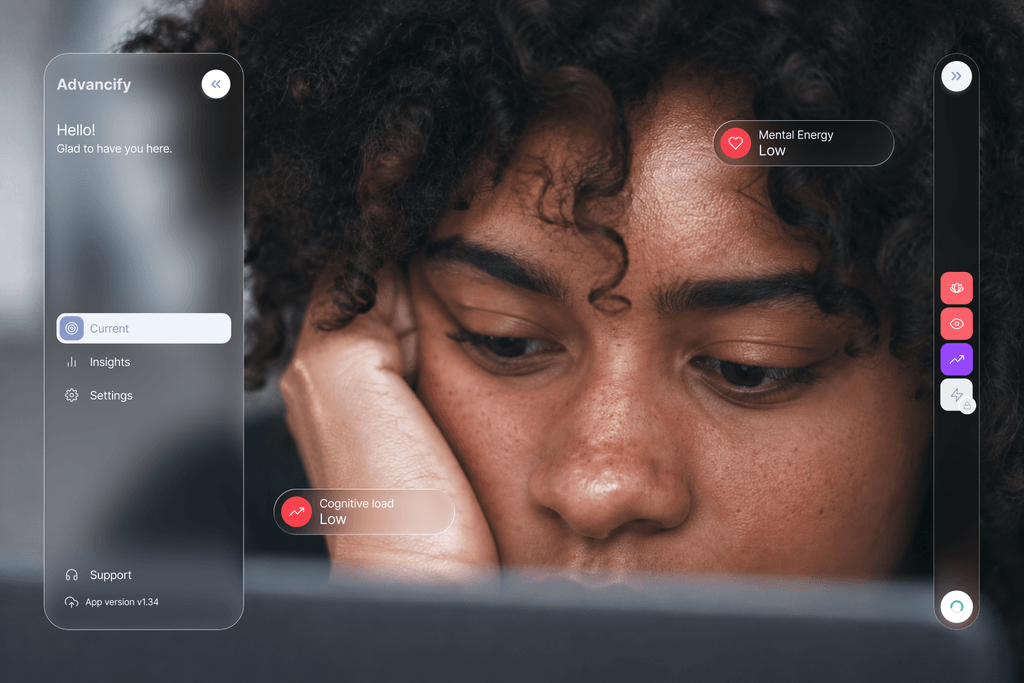
Advancify, a desktop app, is built on these principles. It uses your laptop’s webcam to turn eye signals into feedback you can act on:
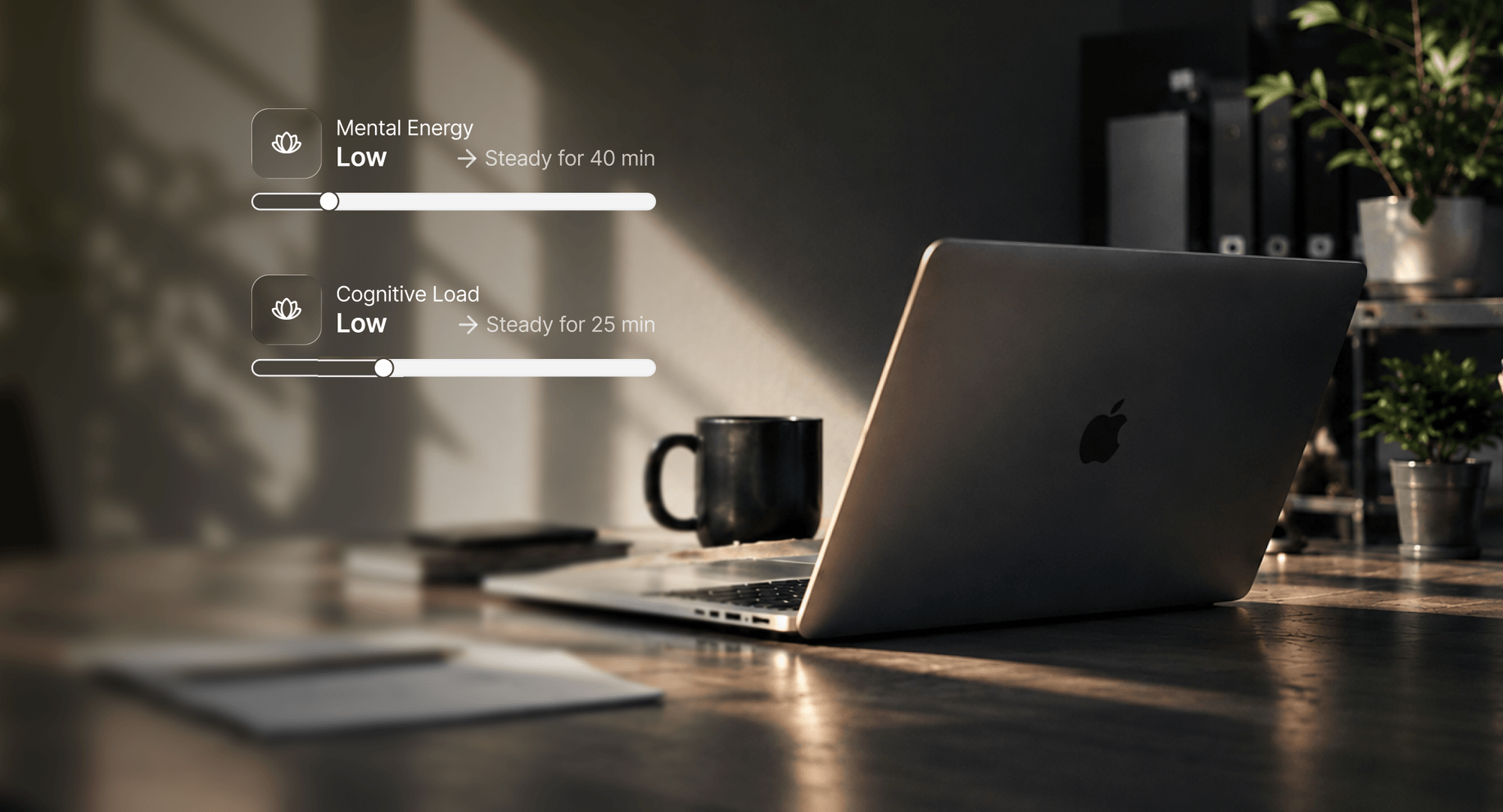
- Shows how your state changes throughout the day. Advancify analyzes eye and pupil landmarks and blink patterns to calculate three practical indicators: Mental Energy, Cognitive Load, and Visual Comfort. A small desktop widget lets you check where you are at a glance.
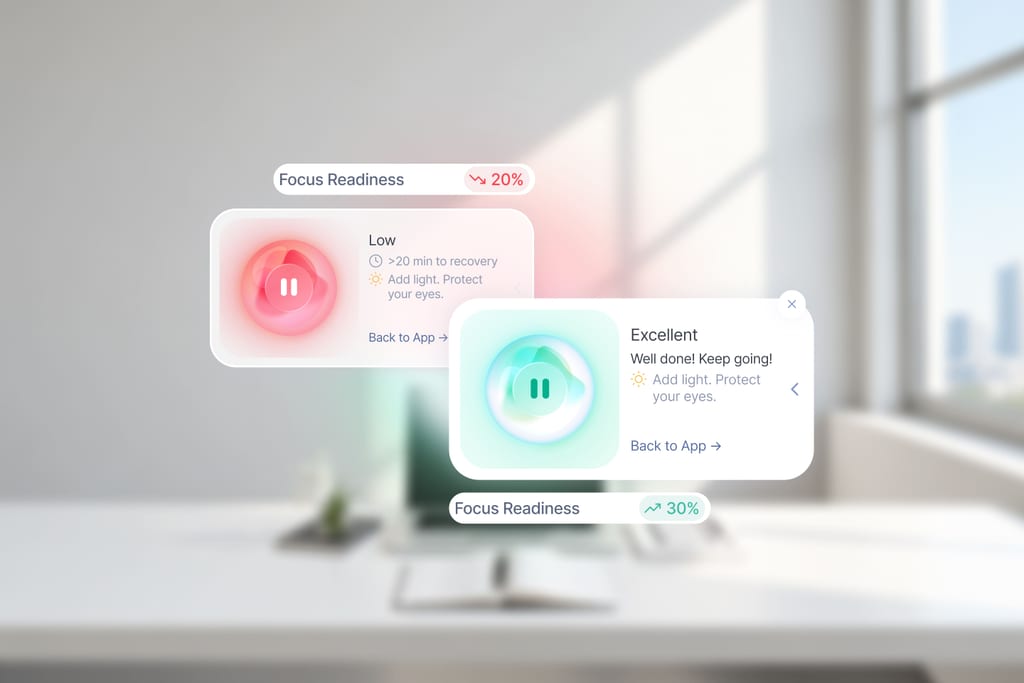
- Flags strain in the moment. Because the app works in real time, it can tell you that your energy is dropping right in the middle of a demanding task, so you step back while a break still helps.
- Reveals your personal rhythm. Daily and weekly charts show when your focus tends to peak and dip, with no scores to live up to, just patterns to plan around.
- Keeps your data private. The app never records, streams, or stores video. The algorithm reads only numerical facial landmark coordinates, and all processing happens locally on your computer.
“Reports always came easily to me. Lately, though, my cognitive load spikes while I write them, but I don’t notice it. I push through like I used to and start making mistakes. Now when the widget says I’m running low, I stop before I’m drained, and getting back into it is easier.”
Ann, 46, market research analyst
Advancify is not a medical device and doesn’t diagnose anything. Its indicators are a guide to your working rhythm, not a measure of your health.
5. Putting it into practice: a simple energy plan
You don’t need to overhaul your schedule overnight. These steps work best together, and they work with or without an app:
- Start mapping your rhythm. Before you change anything, observe. With Advancify’s free 7-day trial, the app calibrates to you in the background; without it, a quick note every couple of hours rating your focus from 1 to 5 will do. Look for patterns, not perfect data.
- Move deep work into your peaks. Once you see your pattern, protect those hours for strategy, writing, analysis, and decisions. Many people discover a clear morning window, but yours may look different, and it may shift over time.
- Give your dips routine work. Email, admin, and familiar tasks fit low-energy stretches. Save meetings that need sharp judgment for when you’re at your best, whenever you can.
- Take breaks before you need them. Short pauses taken early protect your focus far better than one long break after you’re already drained. A notification is a useful nudge to stand up, look away from the screen, and reset.
- Protect your sleep. Since sleep quality often dips as hormones shift, a consistent bedtime, a cool bedroom, and less late-evening screen time matter more than they used to.
- Talk to your doctor. If brain fog, poor sleep, or fatigue is disrupting your work or life, bring it up with a healthcare provider. Symptoms linked to age-related hormonal changes are common, and many of them can be treated.
What this can look like
Over the first few days, Advancify learns your baseline, and patterns slowly start to emerge. Maybe you notice that your focus tends to be strongest between 9 and 11:30 a.m. and dips around 2 p.m. You try moving your budget review to the morning, scheduling calls after lunch, and stepping away for ten minutes when the app flags rising load mid-afternoon. The workload is the same, but the evening crash starts to feel softer.
The first week is a starting point, not a final answer. Because your rhythm keeps shifting with sleep, stress, and hormones, the picture gets clearer the longer you explore it. Start with Advancify’s free 7-day trial, and keep going as you discover what works for you.
The bottom line
After 40, your greatest professional assets are your experience, deep expertise, and sound judgment. To keep those assets performing at their best, they need a reliable energy foundation. That starts with knowing your rhythm, working with it instead of against it, and stepping back before you run out. Shifting from rigid time management to mindful energy management isn’t a sign of weakness. It’s a smart, science-backed approach to your career and well-being.
Sources and scientific references
- Brain energy metabolism during the menopause transition. Mosconi, L., et al. (2021). Menopause impacts human brain structure, connectivity, energy metabolism, and amyloid-beta deposition. Scientific Reports. Read the full study. www.nature.com
- Cognitive changes and practice effects on repeat testing (SWAN). Study of Women’s Health Across the Nation. Memory and Cognition During and After the Menopause Transition. Original study: Greendale, G. A., et al. (2009). Effects of the menopause transition and hormone use on cognitive performance in midlife women. Neurology, 72(21), 1850–1857. Read the SWAN fact sheet (PDF) · Read the original study. www.swanstudy.org
- Menopausal symptoms at work (survey of 407 hospital employees). O’Neill, M. T., Jones, V., & Reid, A. (2023). Impact of menopausal symptoms on work and careers: a cross-sectional study. Occupational Medicine, 73(6), 332–338. Read the full study. academic.oup.com
- Sleep changes during perimenopause. Harvard T.H. Chan School of Public Health. (May 2026). A Transition of Seasons: Sleep Patterns and Changes in Perimenopause. Apple Women’s Health Study. Read the Harvard study update. hsph.harvard.edu
- Sleep, melatonin, and the menopause transition. Jehan, S., et al. (2017). Sleep, Melatonin, and the Menopausal Transition: What Are the Links? Sleep Science, 10(1), 11–18. Elsevier withdrew the early online version due to a publication error. The journal version is available through PubMed Central. Read the full review · View the publisher’s notice. pmc.ncbi.nlm.nih.gov
- Pupil size and blink rate under cognitive load. Biondi, F. N., Saberi, B., Graf, F., Cort, J., Pillai, P., & Balasingam, B. (2023). Distracted worker: Using pupil size and blink rate to detect cognitive load during manufacturing tasks. Applied Ergonomics, 106, 103867. Read the abstract on PubMed · View the publisher’s page. pubmed.ncbi.nlm.nih.gov
- Webcam-based blink detection during computer tasks. Vasta, N., Jajo, N., Graf, F., Zhang, L., & Biondi, F. N. (2025). Evaluating a Camera-Based Approach to Assess Cognitive Load During Manufacturing Computer Tasks. Electronics, 14(3), 467. Read the full study. www.mdpi.com
- Eye tracking and cognitive load during a working memory task in virtual reality. Tsigarides, J., Bowler, J. O., Dainty, J., Bagnall, A., & Macgregor, A. (2026). VR-FOCUS: evaluating eye tracking during a virtual reality N-back task as a marker of cognitive load in chronic pain. Scientific Reports. Read the article in press (PDF). www.nature.com
- Gaze behavior under cognitive load during everyday tasks. Martinez-Cedillo, A. P., Gavrila, N., Mishra, A., Geangu, E., & Foulsham, T. (2025). Cognitive load affects gaze dynamics during real-world tasks. Experimental Brain Research, 243(4), 82. Read the full study. link.springer.com
- Blink duration and mental workload in working memory tasks. Wiediartini, Ciptomulyono, U., & Dewi, R. S. (2024). Evaluation of physiological responses to mental workload in n-back and arithmetic tasks. Ergonomics, 67(8), 1121–1133. Read the abstract on PubMed · View the publisher’s page. pubmed.ncbi.nlm.nih.gov