Mental fatigue doesn’t just cause mistakes. It makes them harder to notice.
'%3e%3cpath%20d='M17.4339%200H1.39001C0.621457%200%200%200.606748%200%201.35691V17.467C0%2018.2172%200.621457%2018.8276%201.39001%2018.8276H17.4339C18.2025%2018.8276%2018.8276%2018.2172%2018.8276%2017.4707V1.35691C18.8276%200.606748%2018.2025%200%2017.4339%200ZM5.58576%2016.0439H2.79104V7.05667H5.58576V16.0439ZM4.1884%205.83214C3.29115%205.83214%202.56673%205.10772%202.56673%204.21414C2.56673%203.32057%203.29115%202.59615%204.1884%202.59615C5.08198%202.59615%205.8064%203.32057%205.8064%204.21414C5.8064%205.10404%205.08198%205.83214%204.1884%205.83214ZM16.0439%2016.0439H13.2529V11.6753C13.2529%2010.6346%2013.2345%209.29244%2011.8003%209.29244C10.3478%209.29244%2010.1272%2010.4287%2010.1272%2011.6018V16.0439H7.33982V7.05667H10.0169V8.28487H10.0536C10.425%207.57884%2011.337%206.83236%2012.6939%206.83236C15.5217%206.83236%2016.0439%208.69305%2016.0439%2011.1127V16.0439V16.0439Z'%20fill='%2315171C'/%3e%3c/g%3e%3cdefs%3e%3cclipPath%20id='clip0_912_10296'%3e%3crect%20width='18.8276'%20height='18.8276'%20fill='white'/%3e%3c/clipPath%3e%3c/defs%3e%3c/svg%3e)

'%3e%3cpath%20d='M9.41379%200C4.21474%200%200%204.21474%200%209.41379C0%2013.8285%203.03953%2017.533%207.1398%2018.5504V12.2906H5.19867V9.41379H7.1398V8.17419C7.1398%204.97011%208.5899%203.48499%2011.7356%203.48499C12.3321%203.48499%2013.3612%203.60209%2013.7822%203.71883V6.32645C13.56%206.3031%2013.174%206.29143%2012.6947%206.29143C11.1512%206.29143%2010.5547%206.87621%2010.5547%208.39635V9.41379H13.6297L13.1014%2012.2906H10.5547V18.7587C15.2161%2018.1957%2018.828%2014.2269%2018.828%209.41379C18.8276%204.21474%2014.6128%200%209.41379%200Z'%20fill='%2315171C'/%3e%3c/g%3e%3cdefs%3e%3cclipPath%20id='clip0_912_10302'%3e%3crect%20width='18.8276'%20height='18.8276'%20fill='white'/%3e%3c/clipPath%3e%3c/defs%3e%3c/svg%3e)
'%3e%3cpath%20d='M9.41379%201.69522C11.929%201.69522%2012.2269%201.70625%2013.2161%201.75038C14.1354%201.79083%2014.6318%201.94527%2014.9628%202.07398C15.4004%202.24313%2015.7166%202.44906%2016.0439%202.77633C16.3749%203.10729%2016.5771%203.41985%2016.7463%203.85745C16.875%204.1884%2017.0294%204.68851%2017.0699%205.60415C17.114%206.59701%2017.125%206.89487%2017.125%209.40644C17.125%2011.9217%2017.114%2012.2195%2017.0699%2013.2087C17.0294%2014.128%2016.875%2014.6245%2016.7463%2014.9554C16.5771%2015.393%2016.3712%2015.7093%2016.0439%2016.0365C15.7129%2016.3675%2015.4004%2016.5697%2014.9628%2016.7389C14.6318%2016.8676%2014.1317%2017.022%2013.2161%2017.0625C12.2232%2017.1066%2011.9254%2017.1177%209.41379%2017.1177C6.89855%2017.1177%206.60069%2017.1066%205.6115%2017.0625C4.69219%2017.022%204.19576%2016.8676%203.8648%2016.7389C3.42721%2016.5697%203.11096%2016.3638%202.78369%2016.0365C2.45273%2015.7056%202.25049%2015.393%202.08133%2014.9554C1.95263%2014.6245%201.79818%2014.1244%201.75773%2013.2087C1.7136%2012.2159%201.70257%2011.918%201.70257%209.40644C1.70257%206.89119%201.7136%206.59333%201.75773%205.60415C1.79818%204.68483%201.95263%204.1884%202.08133%203.85745C2.25049%203.41985%202.45641%203.10361%202.78369%202.77633C3.11464%202.44538%203.42721%202.24313%203.8648%202.07398C4.19576%201.94527%204.69587%201.79083%205.6115%201.75038C6.60069%201.70625%206.89855%201.69522%209.41379%201.69522ZM9.41379%200C6.8581%200%206.53817%200.0110318%205.53428%200.0551589C4.53407%200.0992861%203.84642%200.261086%203.2507%200.492753C2.62924%200.735452%202.10339%201.05537%201.58122%201.58122C1.05537%202.10339%200.735453%202.62924%200.492753%203.24702C0.261086%203.84642%200.0992861%204.53039%200.055159%205.5306C0.0110318%206.53817%200%206.8581%200%209.41379C0%2011.9695%200.0110318%2012.2894%200.055159%2013.2933C0.0992861%2014.2935%200.261086%2014.9812%200.492753%2015.5769C0.735453%2016.1983%201.05537%2016.7242%201.58122%2017.2464C2.10339%2017.7685%202.62924%2018.0921%203.24702%2018.3312C3.84642%2018.5628%204.53039%2018.7246%205.5306%2018.7687C6.5345%2018.8129%206.85442%2018.8239%209.41012%2018.8239C11.9658%2018.8239%2012.2857%2018.8129%2013.2896%2018.7687C14.2898%2018.7246%2014.9775%2018.5628%2015.5732%2018.3312C16.191%2018.0921%2016.7168%2017.7685%2017.239%2017.2464C17.7612%2016.7242%2018.0848%2016.1983%2018.3238%2015.5806C18.5555%2014.9812%2018.7173%2014.2972%2018.7614%2013.297C18.8055%2012.2931%2018.8166%2011.9732%2018.8166%209.41747C18.8166%206.86177%2018.8055%206.54185%2018.7614%205.53796C18.7173%204.53774%2018.5555%203.85009%2018.3238%203.25438C18.0921%202.62924%2017.7722%202.10339%2017.2464%201.58122C16.7242%201.05905%2016.1983%200.735453%2015.5806%200.49643C14.9812%200.264763%2014.2972%200.102963%2013.297%200.0588362C12.2894%200.0110318%2011.9695%200%209.41379%200Z'%20fill='%2315171C'/%3e%3cpath%20d='M9.41373%204.57825C6.74403%204.57825%204.57812%206.74416%204.57812%209.41385C4.57812%2012.0835%206.74403%2014.2494%209.41373%2014.2494C12.0834%2014.2494%2014.2493%2012.0835%2014.2493%209.41385C14.2493%206.74416%2012.0834%204.57825%209.41373%204.57825ZM9.41373%2012.5506C7.68174%2012.5506%206.27702%2011.1458%206.27702%209.41385C6.27702%207.68186%207.68174%206.27714%209.41373%206.27714C11.1457%206.27714%2012.5504%207.68186%2012.5504%209.41385C12.5504%2011.1458%2011.1457%2012.5506%209.41373%2012.5506Z'%20fill='%2315171C'/%3e%3cpath%20d='M15.5694%204.38698C15.5694%205.01211%2015.0619%205.5159%2014.4404%205.5159C13.8153%205.5159%2013.3115%205.00844%2013.3115%204.38698C13.3115%203.76184%2013.819%203.25806%2014.4404%203.25806C15.0619%203.25806%2015.5694%203.76552%2015.5694%204.38698Z'%20fill='%2315171C'/%3e%3c/g%3e%3cdefs%3e%3cclipPath%20id='clip0_912_10305'%3e%3crect%20width='18.8276'%20height='18.8276'%20fill='white'/%3e%3c/clipPath%3e%3c/defs%3e%3c/svg%3e)

There’s an experiment that helps explain why, after several hours of work, you can’t always fully trust the feeling that “I’m still doing fine.”
In 2006, researchers at the University of Groningen recruited 19 healthy students and asked them to perform the same task continuously for more than two hours without a break.
The letters H and S appeared on a screen. Participants had to press the corresponding button with their left or right hand as quickly as possible. But the position of the letter sometimes prompted the wrong response, creating a conflict between the automatic reaction and the correct answer.
The task itself wasn’t particularly difficult. The challenge was having to perform it again and again while maintaining speed and accuracy for several hours.
Over the course of the experiment, each participant completed approximately 3,500 to 4,000 trials.
The researchers measured three things at the same time: how quickly people responded, how many mistakes they made, and what happened in the brain when they made an error.
As mental fatigue accumulated, performance began to decline.
During the first twenty minutes, 9.2% of responses were incorrect. During the final twenty minutes of the two hour period, that figure had risen to 12.9%.
That’s an increase of roughly 40%.
Significant, but hardly catastrophic.
What happened next was much more interesting.
The researchers looked not only at how many mistakes people made, but also at what they did immediately after making one.
At the beginning of the experiment, participants immediately corrected around 73% of their errors.
After two hours, they corrected only about 39%.
In other words, as mental fatigue increased, two things were happening at the same time:
people were making more mistakes;
and they were becoming worse at responding to their own mistakes.
The researchers observed changes not only in behavior, but also in brain activity.
After an error, the brain normally produces a characteristic electrical response called ERN, or error related negativity. It is associated with the brain’s action monitoring system, essentially signaling that something went wrong and the outcome did not match what was expected.
After two hours of continuous work, the amplitude of the ERN decreased substantially, by roughly threefold.
Behavior after an error changed as well. Normally, after making a mistake, people slow down slightly on the next attempt and respond more cautiously. This phenomenon is known as post error slowing. It was present at the beginning of the experiment but had almost disappeared by the end of the two hour work period.
And this is where one of the more troubling aspects of mental fatigue appears.
We intuitively imagine the process like this:
fatigue builds → concentration gets harder → mistakes increase → you notice → you take a break.
But the chain can begin to fail at exactly the point we rely on most:
“you notice.”
With prolonged mental effort, it may not only become harder to perform the task. The monitoring system that helps you detect your own mistakes and adjust your behavior can become less effective too.
This creates a potentially self reinforcing cycle:
fatigue builds → mistakes increase → error monitoring weakens → fewer mistakes trigger immediate correction → work continues → fatigue keeps accumulating.
That’s why the moment when you most need a break may not be the same moment when you realize you need one.
“I’m still working fine” isn’t a perfect indicator
This is one of the problems with prolonged mental work. As task performance declines, the quality of your internal feedback may decline as well.
It creates a strange paradox.
Your brain is trying to evaluate its own fatigue while becoming less effective at detecting the mistakes it makes.
And your inner voice rarely says:
“Apparently, my brain’s action monitoring has become less effective. I should take some time to recover.”
Instead, it usually sounds more like this:
“I’ll just finish the document now so I don’t have to come back to it.”
“I can easily work another hour, then I’ll take a proper break.”
“I don’t really feel that tired. I’m not making that many mistakes.”
“I just need to focus harder and finish this.”
Then morning comes.
You open the presentation or important email you reviewed several times the night before and were convinced was finished.
Within a minute, you find three typos, a duplicated paragraph, and a sentence you can no longer understand why you wrote.
The mistakes were there yesterday too.
You simply didn’t notice them when you were tired and your attention had declined.
Of course, the experiment by Boksem and colleagues does not prove that this exact mechanism is responsible for your late night typos. But it demonstrates a broader and more important effect: during prolonged mental work, both task performance and the monitoring of your own actions can deteriorate.
So the subjective feeling that “I’m still working fine” doesn’t necessarily mean that the quality of your work has actually remained the same.
Can you overcome mental fatigue by trying harder?
The researchers tested that too.
After the prolonged task, participants were told that the person with the best performance would receive $25.
In other words, after hours of monotonous work, they were given a concrete reason to pull themselves together and perform at their best again.
And it worked.
Participants were able to mobilize, and some aspects of their performance improved.
But they could not fully return to their original level of performance.
No one was able to restore both speed and accuracy at the same time.
Those who became more accurate paid for it by becoming slower.
Those who tried to regain their speed made more mistakes.
This reveals an important distinction:
motivation can help you temporarily mobilize your resources, but it doesn’t erase accumulated mental fatigue.
When you’re facing a deadline, you can absolutely tell yourself:
“I’m going to focus and get this done.”
And for a while, it may work.
But that doesn’t mean your brain has returned to the same state it was in when you started working. More likely, you’re asking it to put more effort into the task despite the fatigue that has already accumulated.
Sometimes that’s necessary. Deadlines, important calls, and unexpected situations aren’t going away.
But an emergency is still an emergency, even if you manage to push through it with willpower.
Motivation is therefore a useful tool for short term mobilization, but a poor substitute for recovery.
And perhaps the most important takeaway from this experiment is this:
Don’t wait until you finally feel that you can no longer work effectively. By that point, your ability to judge the quality of your own work may already be worse than it was a few hours earlier.
How Advancify can help you recognize mental fatigue earlier
The problem is that we often decide when to take a break based on how we feel:
“I’m still working fine, so I can keep going.”
But as the experiment suggests, during prolonged work, your internal monitoring can become less reliable too. This is where Advancify can provide additional context.
Instead of relying only on the feeling of “I’m tired” or “I’m not tired,” Advancify tracks changes in your work patterns throughout the day and helps you see when signs of increasing load and reduced readiness for sustained mental work begin to appear.
For example, you may be thinking:
“I’m still working fine.”
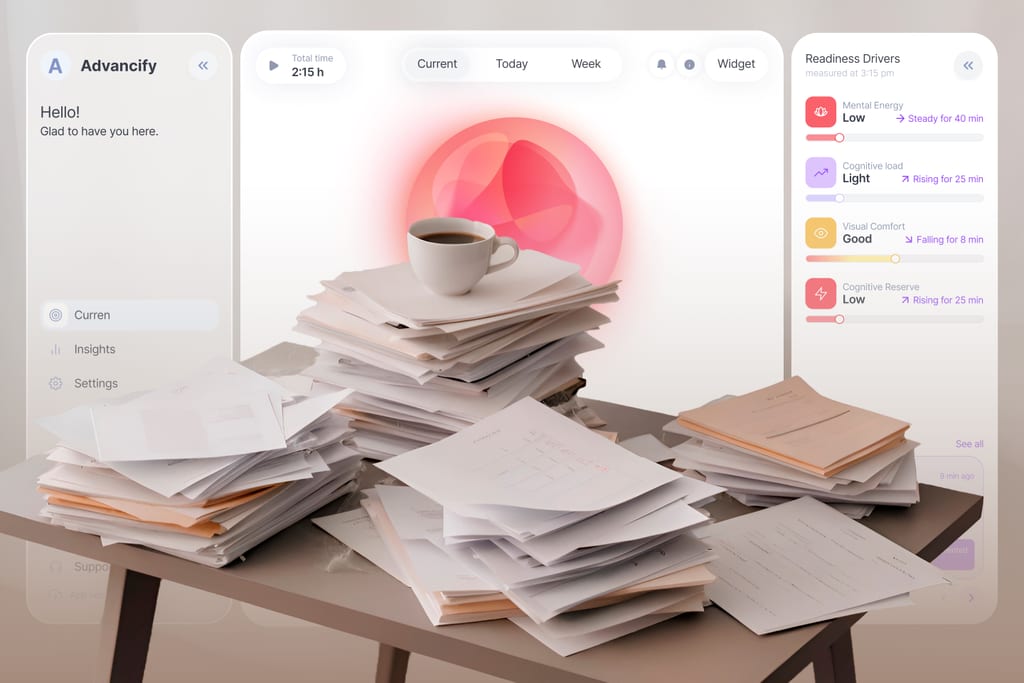
But Advancify may already show that your Mental Energy is declining, your Cognitive Reserve is becoming more limited, and your current Cognitive Load has remained high for more than an hour.
That doesn’t mean the app knows how many mistakes you’re about to make.
It gives you an additional source of external feedback at a point when relying on subjective feelings alone may not be enough.
As a result, the decision to take a break doesn’t have to be based solely on:
“I’ll stop when I feel completely exhausted.”
It can also take into account how your state has changed over the course of your work.
This is particularly relevant in the context of the experiment by Boksem and colleagues.
If prolonged mental work can simultaneously increase errors and weaken the response to those errors, it can be useful to have an additional signal that doesn’t require you to wait until the decline in your work becomes obvious.
Instead of waiting until mental fatigue becomes visible in the quality of your work, you can recognize changes in your state earlier.
Source
Boksem, M. A. S., Meijman, T. F., & Lorist, M. M. (2006). Mental fatigue, motivation and action monitoring. Biological Psychology, 72(2), 123–132.