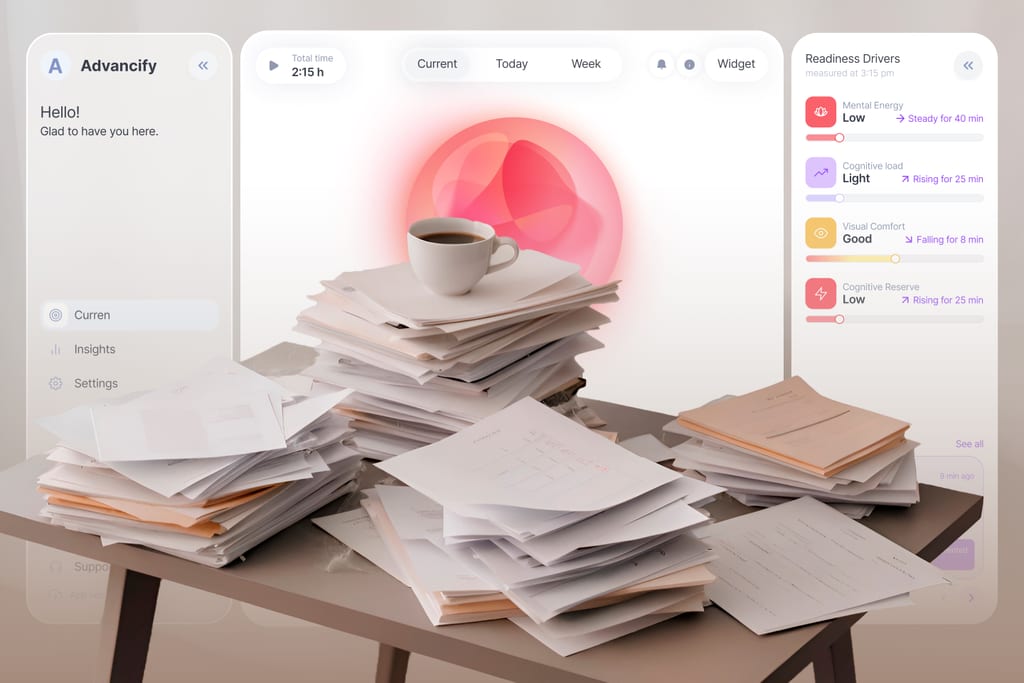
Why the same work can feel completely different on different days
'%3e%3cpath%20d='M17.4339%200H1.39001C0.621457%200%200%200.606748%200%201.35691V17.467C0%2018.2172%200.621457%2018.8276%201.39001%2018.8276H17.4339C18.2025%2018.8276%2018.8276%2018.2172%2018.8276%2017.4707V1.35691C18.8276%200.606748%2018.2025%200%2017.4339%200ZM5.58576%2016.0439H2.79104V7.05667H5.58576V16.0439ZM4.1884%205.83214C3.29115%205.83214%202.56673%205.10772%202.56673%204.21414C2.56673%203.32057%203.29115%202.59615%204.1884%202.59615C5.08198%202.59615%205.8064%203.32057%205.8064%204.21414C5.8064%205.10404%205.08198%205.83214%204.1884%205.83214ZM16.0439%2016.0439H13.2529V11.6753C13.2529%2010.6346%2013.2345%209.29244%2011.8003%209.29244C10.3478%209.29244%2010.1272%2010.4287%2010.1272%2011.6018V16.0439H7.33982V7.05667H10.0169V8.28487H10.0536C10.425%207.57884%2011.337%206.83236%2012.6939%206.83236C15.5217%206.83236%2016.0439%208.69305%2016.0439%2011.1127V16.0439V16.0439Z'%20fill='%2315171C'/%3e%3c/g%3e%3cdefs%3e%3cclipPath%20id='clip0_912_10296'%3e%3crect%20width='18.8276'%20height='18.8276'%20fill='white'/%3e%3c/clipPath%3e%3c/defs%3e%3c/svg%3e)

'%3e%3cpath%20d='M9.41379%200C4.21474%200%200%204.21474%200%209.41379C0%2013.8285%203.03953%2017.533%207.1398%2018.5504V12.2906H5.19867V9.41379H7.1398V8.17419C7.1398%204.97011%208.5899%203.48499%2011.7356%203.48499C12.3321%203.48499%2013.3612%203.60209%2013.7822%203.71883V6.32645C13.56%206.3031%2013.174%206.29143%2012.6947%206.29143C11.1512%206.29143%2010.5547%206.87621%2010.5547%208.39635V9.41379H13.6297L13.1014%2012.2906H10.5547V18.7587C15.2161%2018.1957%2018.828%2014.2269%2018.828%209.41379C18.8276%204.21474%2014.6128%200%209.41379%200Z'%20fill='%2315171C'/%3e%3c/g%3e%3cdefs%3e%3cclipPath%20id='clip0_912_10302'%3e%3crect%20width='18.8276'%20height='18.8276'%20fill='white'/%3e%3c/clipPath%3e%3c/defs%3e%3c/svg%3e)
'%3e%3cpath%20d='M9.41379%201.69522C11.929%201.69522%2012.2269%201.70625%2013.2161%201.75038C14.1354%201.79083%2014.6318%201.94527%2014.9628%202.07398C15.4004%202.24313%2015.7166%202.44906%2016.0439%202.77633C16.3749%203.10729%2016.5771%203.41985%2016.7463%203.85745C16.875%204.1884%2017.0294%204.68851%2017.0699%205.60415C17.114%206.59701%2017.125%206.89487%2017.125%209.40644C17.125%2011.9217%2017.114%2012.2195%2017.0699%2013.2087C17.0294%2014.128%2016.875%2014.6245%2016.7463%2014.9554C16.5771%2015.393%2016.3712%2015.7093%2016.0439%2016.0365C15.7129%2016.3675%2015.4004%2016.5697%2014.9628%2016.7389C14.6318%2016.8676%2014.1317%2017.022%2013.2161%2017.0625C12.2232%2017.1066%2011.9254%2017.1177%209.41379%2017.1177C6.89855%2017.1177%206.60069%2017.1066%205.6115%2017.0625C4.69219%2017.022%204.19576%2016.8676%203.8648%2016.7389C3.42721%2016.5697%203.11096%2016.3638%202.78369%2016.0365C2.45273%2015.7056%202.25049%2015.393%202.08133%2014.9554C1.95263%2014.6245%201.79818%2014.1244%201.75773%2013.2087C1.7136%2012.2159%201.70257%2011.918%201.70257%209.40644C1.70257%206.89119%201.7136%206.59333%201.75773%205.60415C1.79818%204.68483%201.95263%204.1884%202.08133%203.85745C2.25049%203.41985%202.45641%203.10361%202.78369%202.77633C3.11464%202.44538%203.42721%202.24313%203.8648%202.07398C4.19576%201.94527%204.69587%201.79083%205.6115%201.75038C6.60069%201.70625%206.89855%201.69522%209.41379%201.69522ZM9.41379%200C6.8581%200%206.53817%200.0110318%205.53428%200.0551589C4.53407%200.0992861%203.84642%200.261086%203.2507%200.492753C2.62924%200.735452%202.10339%201.05537%201.58122%201.58122C1.05537%202.10339%200.735453%202.62924%200.492753%203.24702C0.261086%203.84642%200.0992861%204.53039%200.055159%205.5306C0.0110318%206.53817%200%206.8581%200%209.41379C0%2011.9695%200.0110318%2012.2894%200.055159%2013.2933C0.0992861%2014.2935%200.261086%2014.9812%200.492753%2015.5769C0.735453%2016.1983%201.05537%2016.7242%201.58122%2017.2464C2.10339%2017.7685%202.62924%2018.0921%203.24702%2018.3312C3.84642%2018.5628%204.53039%2018.7246%205.5306%2018.7687C6.5345%2018.8129%206.85442%2018.8239%209.41012%2018.8239C11.9658%2018.8239%2012.2857%2018.8129%2013.2896%2018.7687C14.2898%2018.7246%2014.9775%2018.5628%2015.5732%2018.3312C16.191%2018.0921%2016.7168%2017.7685%2017.239%2017.2464C17.7612%2016.7242%2018.0848%2016.1983%2018.3238%2015.5806C18.5555%2014.9812%2018.7173%2014.2972%2018.7614%2013.297C18.8055%2012.2931%2018.8166%2011.9732%2018.8166%209.41747C18.8166%206.86177%2018.8055%206.54185%2018.7614%205.53796C18.7173%204.53774%2018.5555%203.85009%2018.3238%203.25438C18.0921%202.62924%2017.7722%202.10339%2017.2464%201.58122C16.7242%201.05905%2016.1983%200.735453%2015.5806%200.49643C14.9812%200.264763%2014.2972%200.102963%2013.297%200.0588362C12.2894%200.0110318%2011.9695%200%209.41379%200Z'%20fill='%2315171C'/%3e%3cpath%20d='M9.41373%204.57825C6.74403%204.57825%204.57812%206.74416%204.57812%209.41385C4.57812%2012.0835%206.74403%2014.2494%209.41373%2014.2494C12.0834%2014.2494%2014.2493%2012.0835%2014.2493%209.41385C14.2493%206.74416%2012.0834%204.57825%209.41373%204.57825ZM9.41373%2012.5506C7.68174%2012.5506%206.27702%2011.1458%206.27702%209.41385C6.27702%207.68186%207.68174%206.27714%209.41373%206.27714C11.1457%206.27714%2012.5504%207.68186%2012.5504%209.41385C12.5504%2011.1458%2011.1457%2012.5506%209.41373%2012.5506Z'%20fill='%2315171C'/%3e%3cpath%20d='M15.5694%204.38698C15.5694%205.01211%2015.0619%205.5159%2014.4404%205.5159C13.8153%205.5159%2013.3115%205.00844%2013.3115%204.38698C13.3115%203.76184%2013.819%203.25806%2014.4404%203.25806C15.0619%203.25806%2015.5694%203.76552%2015.5694%204.38698Z'%20fill='%2315171C'/%3e%3c/g%3e%3cdefs%3e%3cclipPath%20id='clip0_912_10305'%3e%3crect%20width='18.8276'%20height='18.8276'%20fill='white'/%3e%3c/clipPath%3e%3c/defs%3e%3c/svg%3e)

Yesterday, you worked on a task for an hour and a half and barely noticed the time passing.
Today, a similar task feels painfully slow after just forty minutes. You get distracted more often, reread things you have already read, and catch yourself thinking that almost anything else would be better to work on.
The task is almost the same.
Less time has even passed.
What changed is the state you were in when you started.
And that is one of the things we often underestimate when planning our workday.
You do not start every task from the same point
When we plan our work, it is convenient to assume that an hour on Tuesday is roughly equivalent to an hour on Thursday.
If a task took an hour and a half yesterday and went reasonably well, it seems logical to expect something similar today.
But you arrive at every work session with a different history behind you.
Today, you may have slept well and done very little demanding work beforehand.
Tomorrow, you may already have had three meetings, made several difficult decisions, spent two hours switching between messages and documents, and only then opened the same task.
The task has not changed.
But your starting point has.
It may be influenced by how much demanding work came before it, how intense the previous period was, whether you had time to recover, and where you are in your daily rhythm.
That is why the same work does not have to feel the same every time.
Sometimes the task has not become harder
It is especially easy to reach the wrong conclusion in situations like this:
“For some reason, I just cannot focus today.”
Or:
“I was much more productive yesterday.”
But comparing two work periods only by how much you completed is not always useful.
Imagine two days.
Monday
You work for 120 minutes.
Mental Energy remains relatively stable.
Cognitive Load stays Engaged for most of the time.
Focus Readiness remains Good.
Thursday
You work for only 90 minutes.
Cognitive Load moves to Intense more quickly.
Mental Energy declines.
Focus Readiness moves toward Reduced.
Thursday's session was shorter. But judging by how your state changed, it was more demanding.
That distinction matters.
The length of a work block tells you how much time passed.
But it does not tell you what state you started in or how much that work changed your state today.
Compare your response, not just the time
One unusual day tells you very little.
Repetition is much more interesting.
If similar work feels completely different several times in a row, look at what happened before it.
Were there meetings beforehand?
Had you already done demanding work?
Was this the first intensive block of the day or the third?
Did you have a proper break before it?
What time of day was it?
What did Mental Energy look like before you started?
You do not need to find one single explanation.
A workday is usually shaped by several factors at once.
But when you compare similar situations, personal patterns begin to emerge.
This is where data becomes more useful than individual readings
Imagine you notice the same pattern several times:
analytical work tends to feel stable in the morning;
Mental Energy declines faster after several meetings;
and the second intensive work block of the day requires noticeably more resources than the first.
One occurrence may be random.
If it keeps happening, it becomes a pattern worth paying attention to.
Over time, Advancify can identify recurring patterns in your data and bring them to your attention through Insights.
Individual workdays gradually begin to form a clearer picture:
the conditions under which your state tends to remain stable, and the conditions under which it begins to change more quickly.
That is the value of longer-term observation.
Not deciding from a single day:
“Am I working well or badly?”
But understanding:
“Under what conditions is it usually easier for me to sustain demanding work?”
Use these patterns when you plan
Once a pattern becomes visible, you can start using it.
If you notice that Mental Energy regularly declines faster after several meetings, you may not want to schedule your most demanding analytical work immediately afterward.
If the first intensive period of the day usually goes well but the second requires much more effort, you can experiment with moving your most important work earlier.
If a similar task consistently goes more smoothly after proper recovery, that is useful information too.
There is no universal rule such as:
“Always do difficult work in the morning.”
Someone else may have a completely different pattern.
What matters is learning:
under what conditions your own state best supports the work you want to do.
So instead of asking:
“Why could I only manage 40 minutes today when I worked comfortably for an hour and a half yesterday?”
a more useful question is:
“What state did I start this work in today, and what happened before it?”
The task may be the same. The state you bring to it is not.
And sometimes that explains the difference better than the number of minutes on a timer.