The timing of your break may matter as much as its length

'%3e%3cpath%20d='M17.4339%200H1.39001C0.621457%200%200%200.606748%200%201.35691V17.467C0%2018.2172%200.621457%2018.8276%201.39001%2018.8276H17.4339C18.2025%2018.8276%2018.8276%2018.2172%2018.8276%2017.4707V1.35691C18.8276%200.606748%2018.2025%200%2017.4339%200ZM5.58576%2016.0439H2.79104V7.05667H5.58576V16.0439ZM4.1884%205.83214C3.29115%205.83214%202.56673%205.10772%202.56673%204.21414C2.56673%203.32057%203.29115%202.59615%204.1884%202.59615C5.08198%202.59615%205.8064%203.32057%205.8064%204.21414C5.8064%205.10404%205.08198%205.83214%204.1884%205.83214ZM16.0439%2016.0439H13.2529V11.6753C13.2529%2010.6346%2013.2345%209.29244%2011.8003%209.29244C10.3478%209.29244%2010.1272%2010.4287%2010.1272%2011.6018V16.0439H7.33982V7.05667H10.0169V8.28487H10.0536C10.425%207.57884%2011.337%206.83236%2012.6939%206.83236C15.5217%206.83236%2016.0439%208.69305%2016.0439%2011.1127V16.0439V16.0439Z'%20fill='%2315171C'/%3e%3c/g%3e%3cdefs%3e%3cclipPath%20id='clip0_912_10296'%3e%3crect%20width='18.8276'%20height='18.8276'%20fill='white'/%3e%3c/clipPath%3e%3c/defs%3e%3c/svg%3e)

'%3e%3cpath%20d='M9.41379%200C4.21474%200%200%204.21474%200%209.41379C0%2013.8285%203.03953%2017.533%207.1398%2018.5504V12.2906H5.19867V9.41379H7.1398V8.17419C7.1398%204.97011%208.5899%203.48499%2011.7356%203.48499C12.3321%203.48499%2013.3612%203.60209%2013.7822%203.71883V6.32645C13.56%206.3031%2013.174%206.29143%2012.6947%206.29143C11.1512%206.29143%2010.5547%206.87621%2010.5547%208.39635V9.41379H13.6297L13.1014%2012.2906H10.5547V18.7587C15.2161%2018.1957%2018.828%2014.2269%2018.828%209.41379C18.8276%204.21474%2014.6128%200%209.41379%200Z'%20fill='%2315171C'/%3e%3c/g%3e%3cdefs%3e%3cclipPath%20id='clip0_912_10302'%3e%3crect%20width='18.8276'%20height='18.8276'%20fill='white'/%3e%3c/clipPath%3e%3c/defs%3e%3c/svg%3e)
'%3e%3cpath%20d='M9.41379%201.69522C11.929%201.69522%2012.2269%201.70625%2013.2161%201.75038C14.1354%201.79083%2014.6318%201.94527%2014.9628%202.07398C15.4004%202.24313%2015.7166%202.44906%2016.0439%202.77633C16.3749%203.10729%2016.5771%203.41985%2016.7463%203.85745C16.875%204.1884%2017.0294%204.68851%2017.0699%205.60415C17.114%206.59701%2017.125%206.89487%2017.125%209.40644C17.125%2011.9217%2017.114%2012.2195%2017.0699%2013.2087C17.0294%2014.128%2016.875%2014.6245%2016.7463%2014.9554C16.5771%2015.393%2016.3712%2015.7093%2016.0439%2016.0365C15.7129%2016.3675%2015.4004%2016.5697%2014.9628%2016.7389C14.6318%2016.8676%2014.1317%2017.022%2013.2161%2017.0625C12.2232%2017.1066%2011.9254%2017.1177%209.41379%2017.1177C6.89855%2017.1177%206.60069%2017.1066%205.6115%2017.0625C4.69219%2017.022%204.19576%2016.8676%203.8648%2016.7389C3.42721%2016.5697%203.11096%2016.3638%202.78369%2016.0365C2.45273%2015.7056%202.25049%2015.393%202.08133%2014.9554C1.95263%2014.6245%201.79818%2014.1244%201.75773%2013.2087C1.7136%2012.2159%201.70257%2011.918%201.70257%209.40644C1.70257%206.89119%201.7136%206.59333%201.75773%205.60415C1.79818%204.68483%201.95263%204.1884%202.08133%203.85745C2.25049%203.41985%202.45641%203.10361%202.78369%202.77633C3.11464%202.44538%203.42721%202.24313%203.8648%202.07398C4.19576%201.94527%204.69587%201.79083%205.6115%201.75038C6.60069%201.70625%206.89855%201.69522%209.41379%201.69522ZM9.41379%200C6.8581%200%206.53817%200.0110318%205.53428%200.0551589C4.53407%200.0992861%203.84642%200.261086%203.2507%200.492753C2.62924%200.735452%202.10339%201.05537%201.58122%201.58122C1.05537%202.10339%200.735453%202.62924%200.492753%203.24702C0.261086%203.84642%200.0992861%204.53039%200.055159%205.5306C0.0110318%206.53817%200%206.8581%200%209.41379C0%2011.9695%200.0110318%2012.2894%200.055159%2013.2933C0.0992861%2014.2935%200.261086%2014.9812%200.492753%2015.5769C0.735453%2016.1983%201.05537%2016.7242%201.58122%2017.2464C2.10339%2017.7685%202.62924%2018.0921%203.24702%2018.3312C3.84642%2018.5628%204.53039%2018.7246%205.5306%2018.7687C6.5345%2018.8129%206.85442%2018.8239%209.41012%2018.8239C11.9658%2018.8239%2012.2857%2018.8129%2013.2896%2018.7687C14.2898%2018.7246%2014.9775%2018.5628%2015.5732%2018.3312C16.191%2018.0921%2016.7168%2017.7685%2017.239%2017.2464C17.7612%2016.7242%2018.0848%2016.1983%2018.3238%2015.5806C18.5555%2014.9812%2018.7173%2014.2972%2018.7614%2013.297C18.8055%2012.2931%2018.8166%2011.9732%2018.8166%209.41747C18.8166%206.86177%2018.8055%206.54185%2018.7614%205.53796C18.7173%204.53774%2018.5555%203.85009%2018.3238%203.25438C18.0921%202.62924%2017.7722%202.10339%2017.2464%201.58122C16.7242%201.05905%2016.1983%200.735453%2015.5806%200.49643C14.9812%200.264763%2014.2972%200.102963%2013.297%200.0588362C12.2894%200.0110318%2011.9695%200%209.41379%200Z'%20fill='%2315171C'/%3e%3cpath%20d='M9.41373%204.57825C6.74403%204.57825%204.57812%206.74416%204.57812%209.41385C4.57812%2012.0835%206.74403%2014.2494%209.41373%2014.2494C12.0834%2014.2494%2014.2493%2012.0835%2014.2493%209.41385C14.2493%206.74416%2012.0834%204.57825%209.41373%204.57825ZM9.41373%2012.5506C7.68174%2012.5506%206.27702%2011.1458%206.27702%209.41385C6.27702%207.68186%207.68174%206.27714%209.41373%206.27714C11.1457%206.27714%2012.5504%207.68186%2012.5504%209.41385C12.5504%2011.1458%2011.1457%2012.5506%209.41373%2012.5506Z'%20fill='%2315171C'/%3e%3cpath%20d='M15.5694%204.38698C15.5694%205.01211%2015.0619%205.5159%2014.4404%205.5159C13.8153%205.5159%2013.3115%205.00844%2013.3115%204.38698C13.3115%203.76184%2013.819%203.25806%2014.4404%203.25806C15.0619%203.25806%2015.5694%203.76552%2015.5694%204.38698Z'%20fill='%2315171C'/%3e%3c/g%3e%3cdefs%3e%3cclipPath%20id='clip0_912_10305'%3e%3crect%20width='18.8276'%20height='18.8276'%20fill='white'/%3e%3c/clipPath%3e%3c/defs%3e%3c/svg%3e)

We know that taking breaks is useful.
But there’s a more interesting question:
When exactly should you take a break?
If timing doesn’t matter, the solution is simple.
Set a timer for 50 minutes. It’s free, it doesn’t need to measure anything, and it does the job perfectly well.
But what if the same five minute break can have a very different effect depending on when you take it?
Then a timer alone may not be enough.
959 real workday breaks
In 2016, researchers Emily Hunter and Cindy Wu followed 95 employees over the course of a workweek.
Instead of running a laboratory experiment, they studied people during their normal working lives.
People worked.
They got tired.
They took breaks when they felt they needed them.
In total, the researchers collected data on 959 breaks.
They found an interesting pattern:
breaks taken earlier in the workday were associated with more effective recovery than breaks taken later.
Put simply, you don’t necessarily need to wait until you’re already exhausted.
A short break may be more useful before you reach that point.
Don’t wait until your battery is empty
We often treat recovery a little like charging a phone.
40% left. Why charge it now?
20%. Still fine.
5%. Now it’s time to find an outlet.
But this logic doesn’t work as well for people.
If you’re already highly fatigued, a short break may not be enough to bring you back to a good working state. The same break taken earlier might have helped prevent fatigue from accumulating to that level in the first place.
This creates an important distinction between two strategies:
taking a break once you’re already tired
and
taking a break before fatigue has had a significant impact on your work.
They’re not the same thing.
The longer you work, the more break timing may matter
Another example of why timely recovery matters comes from a study of real workplace accidents at a large engineering plant.
Researchers analyzed three years of data and examined how accident risk changed within work periods between breaks.
Each work period lasted two hours.
As continuous work progressed during those two hours, the risk of an accident increased.
During the final 30 minutes of a work period, the relative risk was approximately twice as high as during the first 30 minutes after the previous break.
These numbers cannot be directly applied to knowledge work. The study measured industrial accidents, not mistakes made by developers writing code, researchers analyzing data, or professionals making complex decisions.
But it illustrates an important pattern:
the cost of the next period of work may depend on how long you’ve already been working without recovery.
That’s why the timing of a break may matter.
Five minutes now and five minutes two hours from now are exactly the same amount of rest.
But they may happen when you’re in very different states and, as a result, lead to very different outcomes.
The problem with a simple break timer
A timer knows the time.
Nothing else.
It doesn’t know how you slept.
It doesn’t know whether you’re in your first hour of work or your fourth.
It doesn’t know whether you’re replying to routine messages or trying to solve a difficult research problem.
It doesn’t know how demanding your previous work has been.
To a timer:
50 minutes = 50 minutes.
For a person, that isn’t always true.
On one day, after 50 minutes you may have just settled into a productive rhythm.
On another, you may already be reading the same sentence for the third time.
Different tasks can also create very different levels of mental load even when they take exactly the same amount of time. Fifty minutes of routine work and fifty minutes of complex analysis look identical on a clock, but they don’t necessarily create the same load for the person doing them.
A fixed interval therefore tries to apply the same rule to different tasks, different people, and different states.
If the work interval is too short, the break reminder may interrupt you while you still feel good and are working effectively.
If it’s too long, recovery may begin only after significant fatigue has already accumulated. At that point, five or ten minutes may no longer be enough to recover.
The problem isn’t the timer itself. It does exactly what it was designed to do: measure time. But it doesn’t measure your fatigue.
The problem is assuming that the same amount of work time always means the same need for recovery.
What if breaks responded to your state instead of the clock?
This kind of approach has already been explored in research on complex systems.
For example, in a 2016 experiment, professional air traffic controllers worked in a realistic air traffic control simulation.
Researchers monitored their mental workload using electroencephalography (EEG).
When the measured workload became too high, the system automatically redistributed some tasks between the human operator and automation.
In other words, the system didn’t respond according to a simple rule:
“30 minutes have passed.”
It responded to something else:
“The state has changed. It’s time to intervene.”
This adaptive approach reduced measured workload and improved human machine system performance.
The principle matters more here than the specific technology:
measure → detect a change → intervene at the right time.
Advancify is built around the same idea
Advancify follows a similar principle: look not only at how long you’ve been working, but also at how your state changes under load.
To learn how to recognize these changes, we conducted more than 20 experiments using electroencephalography (EEG) and eye tracking. In these experiments, we simultaneously tracked cognitive load and changes in eye behavior while participants performed different tasks.
This allowed us to identify patterns connecting changes in cognitive load with observable characteristics of eye behavior. The experimental data were then used to pretrain Advancify’s neural network models.
The goal was to bring the principle of state based measurement out of the experimental environment and into everyday work.
Unlike EEG research, which requires specialized equipment and electrodes, Advancify is designed to work seamlessly during normal computer use. It uses the standard webcam on your Mac to analyze available signals, including blinking patterns, eye movements, and other characteristics of visual interaction.
Advancify looks not only at how much time has passed, but also at how demanding your current work is and how your state changes as that work continues.
That means two identical hours of work can look very different.
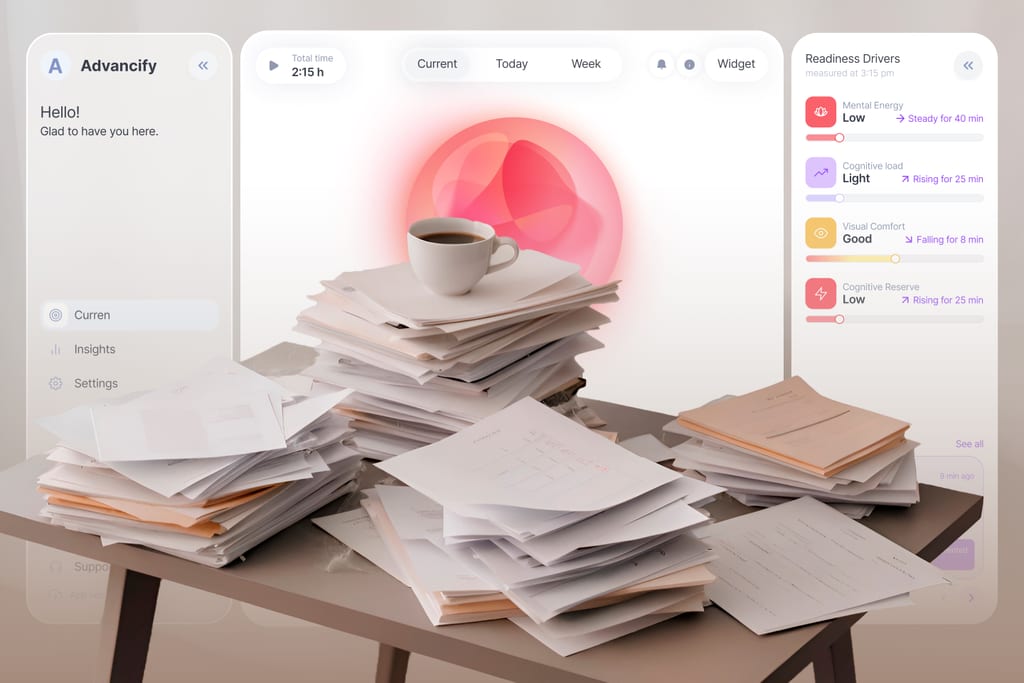
For example, two hours of familiar work may be accompanied by relatively stable Mental Energy and Cognitive Reserve, with moderate Cognitive Load.
Intensive work on a difficult task, on the other hand, may create high Cognitive Load and be accompanied by a faster decline in Mental Energy and Cognitive Reserve. In that case, the need for recovery may arise much sooner, even if less time has passed.
Over time, Advancify adapts to your individual patterns. This allows it to account not only for how long you’ve been working and the patterns identified through research, but also for how you personally respond to different types and durations of workload.
The idea is simple:
recovery shouldn’t be determined by the clock alone. It should also take into account how demanding your work has been and how your state has changed while doing it.
Because effective recovery isn’t only about asking:
“How long should I take a break?”
There’s another question that matters just as much:
“When do I actually need one?”
Sources
Hunter, E. M., & Wu, C. (2016). Give me a better break: Choosing workday break activities to maximize resource recovery. Journal of Applied Psychology, 101(2), 302–311.
Tucker, P., Folkard, S., & Macdonald, I. (2003). Rest breaks and accident risk. The Lancet, 361(9358), 680.